
CGE-BASED IMPACT STUDIES
The Computable General Equilibrium (CGE) Framework
CGE modelling provides a framework for analysing economic changes across interconnected industries and regions. The research question determines the model configuration, the data requirements and the assumptions used in the study.
A CGE model combines economic relationships with observed data to examine how a specified change affects an economy. It represents interactions between households, firms, government and international trade within a consistent framework.
In a bottom-up regional model, regions and industries are represented explicitly. A change in one part of the economy can spread through input–output relationships, trade and factor markets. Prices and quantities adjust together, allowing the analysis to capture indirect effects and feedback mechanisms.
Results compare a defined scenario with a reference case. They show outcomes conditional on the model, data and assumptions; they do not constitute an unconditional prediction of future events. Short- and long-run adjustments are distinguished where the model configuration permits.
CGE Modelling
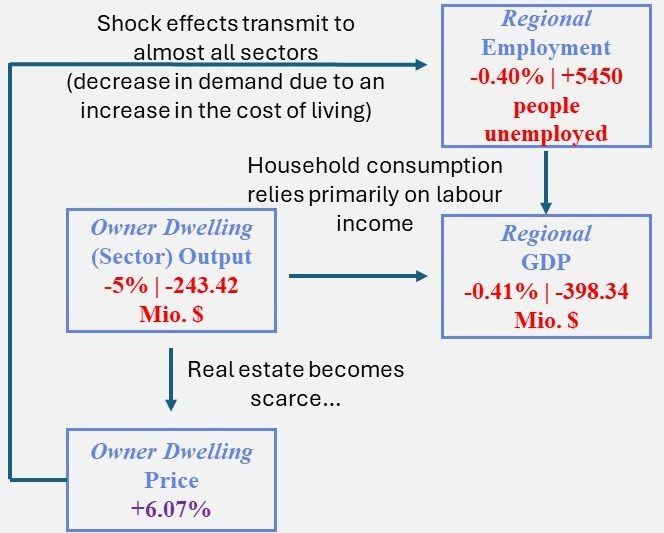
The model makes the behaviour of economic agents explicit. Household demand responds to income and prices. Firms use labour, capital and intermediate inputs to produce goods and services, choosing input combinations in response to costs and technological constraints. Government activity and international transactions complete the economic structure.
Assumptions about labour-market adjustment, capital mobility and other constraints determine how an economy responds to a shock. These assumptions are selected to suit the question and time horizon, and are explained alongside the results.
This approach connects the estimated effects to the mechanisms behind them. Where relevant, alternative assumptions and sensitivity analyses help assess how robust the conclusions are.
Economic Behaviour & Adjustment Processes
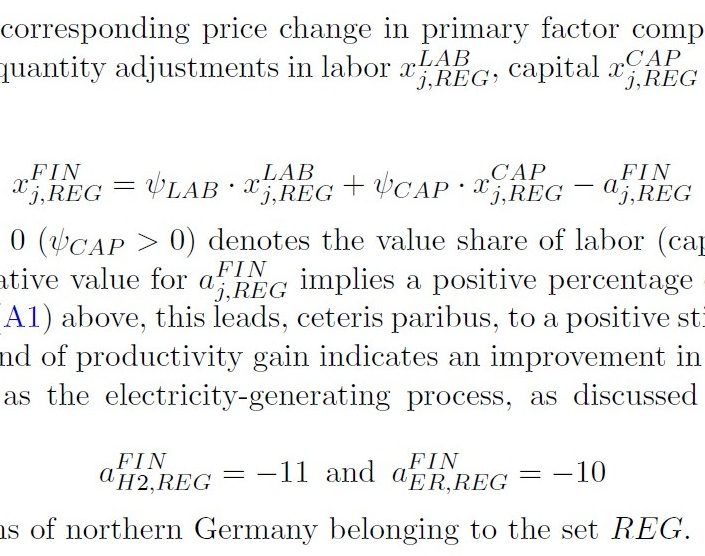
A study requires a coherent database that matches its regional and sectoral scope. Depending on the project, this can draw on official statistics, input–output data and international trade databases such as GTAP (Global Trade Analysis Project), supplemented by relevant project information.
The level of regional and industry detail is agreed with the client, subject to data availability and the model configuration. Aggregations such as the rest of Europe or the rest of the world are chosen to retain the distinctions relevant to the analysis.
The study documents data sources, reference years, necessary updates and important assumptions. More detail is useful when it supports the research question and is backed by suitable data. Contact me to discuss the model and data requirements for your project.
Data matched to your
Research Question

© 2026 Stephen Sacht (S8IS). All rights reserved.